

.png)
ICH DOMAIN (3) SOCIAL PRACTICES, RITUALS, AND FESTIVE EVENTS

3.1 Festivals and Social Customs
Surviving
Celebrations and activities that are held throughout the year and practiced by many residents/citizens.

3.1.1 St. Maarten Carnival
Thriving
Held annually after the lent season in April. It is a time of public revelry and celebration involving colorful children and adult parades, music, dancing, and shows.

3.1.2 St. Martin Day Celebration
Thriving
Celebrated annually on November 11th. Governments of the French and Dutch sides alternate each year to host a number of festivities, including swim races, kite-making competitions, dominoes tournaments, cultural parades, traditional food/drink sales, and cook-offs. The colors of the St. Maarten flag—red, white, and blue—are widely decorated around the island and worn by people to commemorate this national event.

3.1.3 Christmas Season, Christmas Day, and Boxing Day Celebrations
Thriving
The Christmas celebrations are usually observed from around December 1 to January 1. During the season, several parties are held, and Philipsburg (capital) is bustling with shoppers and shopping. Christmas trees and lights are widely purchased and homes are decorated inside and outside. Specific foods/drinks are made during this time, and gifts are exchanged among families, friends, and colleagues. Boxing Day, an official holiday after Christmas, is used to continue the Christmas celebration or for leisure time or rest

3.1.4 Old Year’s and New Year’s (Eve)
Declining
During Old Year’s, several people attend church and/or gather in the main town of Philipsburg and other villages such as Maho to watch fireworks at midnight. Well wishes are exchanged, and several parties are held after the fireworks display.

3.1.5 Easter Traditions Associated with Ash Wednesday, Palm Sunday, Good Friday, and Easter Monday
Thriving
On Ash Wednesday the cross of ashes is placed on the foreheads of Roman Catholics. During the Easter season, churches hold Palm Sunday parades, give out palms, and make crosses out of palms. In addition, during the Easter weekend, there are beach picnics, camping, egg hunts, and avoidance of meat on Good Friday.

3.2 Traditional Rituals/ Ceremonies
Surviving
Secular or non-secular routines/methods widely practiced among families and individuals throughout their lives

3.2.1 Baby Baptism/ Christening
Thriving
A religious ceremony where a baby has water poured on him/her to symbolize initiation into the Christian faith

3.2.2 Adult Baptism
Thriving
A religious ceremony where adults are immersed into water or sprinkled with water, symbolizing purification or regeneration and admission to the Christian church

3.2.3 Baby Protection Rituals
Declining
Rituals are performed to protect babies and ensure their healthy upbringing.
-Placing of an open Bible in the baby’s cradle, sometimes with scissors placed on the Bible for God’s protection.
-Passing the baby over the coffin of a close relative who has passed on so that the person’s spirit does not harm the baby.

3.2.4 Courting Rituals
Declining
Young man asking the father of a young woman permission to date her.

3.2.5 Wedding
Thriving
A ceremony in which two people get married.

3.2.6 Wake, Funeral, and Burial
Thriving
The wake is a social gathering associated with death and held before burial. Traditionally held at the deceased person’s home, more and more it is being held at a funeral parlor or public space. A funeral is a ceremony connected with the burial, interment, or cremation of a deceased person.

3.2.6.1 Burial Practices
Thriving
Throwing all funeral ribbons and personal items in the coffin; throwing dust on the closed coffin.

3.2.7 Holy Communion
Thriving
Holy Communion is an important religious service in the Christian church in which bread and wine are consecrated and shared as a symbol of the Last Supper and the death of Christ.

3.2.8 First Communion
Thriving
First Communion is a ceremony in some Christian traditions/churches during which a person first receives the Eucharist, also called Holy Communion or the Lord's Supper. In churches that celebrate First Communion, it occurs only after receiving of Baptism, and once the person has reached the age of reason (between seven and thirteen), often acting as a rite of passage. For Catholics, Holy Communion is the third of seven sacraments received.

3.2.9 Confirmation
Thriving
Confirmation is seen as the sealing of Christianity created in baptism. It is a ceremony in which a baptized person, especially one baptized as an infant, affirms Christian belief and is admitted as a full member of the Roman Catholic church.

3.2.10 Jollification
Declining
A traditional gathering of people to help build a house, well, or fence and at which food is served as compensation.

3.3 Traditional/Popular Sports and Hobbies
Thriving
Sports and hobbies widely practiced and taught throughout the country for leisure, physical activity and/or pleasure.

3.3.1 Whistling
Surviving
To produce a high-pitched sound or a clear musical sound by forcing air through a small hole between one's lips or teeth. It is usually done for recreational purposes.

3.3.2 Volleyball
Thriving
An indoor/outdoor team sport played on a (18 by 9 meters) court and involving hitting a ball over a net with the objective to score by getting the ball to fall on the opponent’s court. In St. Maarten it is played indoors and on the beach.

3.3.3 Cricket
Thriving
An outdoor bat and ball sport played on a field with a 22-meter pitch at the center and a wicket, made of bails and stumps, at each end. The two teams either bat first or last to make all their rounds at that time.

3.3.4 Softball
Thriving
An outdoor bat and ball sport, similar to baseball, but played on a smaller field with a softer ball. In St. Maarten, it is currently played at the John Cooper/Jose Lake Sr. Ballpark.

3.3.5 Baseball
Thriving
A bat and ball game played between two teams of nine, taking turns to bat during nine innings. The field comprises a diamond shaped circuit of four bases, which the player must pass in order to score points.

3.3.6 Football (Soccer)
Thriving
An outdoor sport played on a field with two teams of eleven players attempting to kick a ball into a net on the opposite side of the field. It is also played indoors but with six players on each team.

3.3.7 Basketball
Thriving
An indoor/outdoor game played by two teams of five players. Goals are scored by throwing a ball through a netted hoop fixed above each end of the court. A court can be found in virtually every district in St. Maarten where one can find teams of two, three, or one-on-one.

3.3.8 Swimming
Thriving
An activity that requires the use of one’s arms and legs to move the body through water. There are swimming clubs that teach old and young to swim. Talented swimmers are coached and represent the island in national and international competitions. Others are self-taught from going to the beach. Swimming lessons are mandatory in primary schools (third grade).
.jpeg)
3.3.9 Fishing
Surviving
An activity of catching fish either for sport or for food. Traditionally, men go out at sea in their fishing boats and fish with home-made nets. The catch of the day is sold—traditionally on a string—to the islanders. Others fish from ashore using a round wooden block with fish line, lead, and bait or with fish pots. Lobsters are caught in shallow areas in fish- or lobster traps. Today, it is more popular for people to fish with modern fishing rods, and many do it merely as a pastime.

3.3.10 Whelking
Declining
The picking of whelks or sea snails from the rocks. They are usually prepared in boiled seawater.

3.3.11 Boat Racing
Thriving
A sport involving the racing of boats. Traditionally it was a competition among local owners of fishing boats, but over the years, it has increased in number of participants and different types of sailing boats, becoming popular during special island holidays and internationally famous with the annually organized Heineken Regatta.

3.1.12 Bicycle Racing/ Cycling
Thriving
A sport or activity of riding a bicycle. In the past racing was mainly part of special festivities, but lately cycling is increasing in popularity with the increase in bike owners, who hold competitions at regular times and events.

3.3.13 Horse Racing
Declining
A sport in which horses and their riders take part in races. Horse and donkey racing was popular in the old times when most households had one of those noble animals. Nowadays, there are some parks where visitors and locals can take lessons or go on excursions in remote areas or swim with the horses in the sea.

3.1.14 Dominoes
Thriving
A strategic game played with a maximum of 4 persons and involving 28 rectangular domino tiles, each with a line dividing it into two squares that are numbered with zero to six dots. The game is highly popular, especially among males but females also participate. Domino tournaments are held throughout the year.

3.3.15 Card Games
Thriving
A popular game that is played by all ages and families using a set of playing cards. Popular card games on St. Maarten are Romie 500, poker, I declare war…

3.1.16 Board Games
Surviving
A game played by persons of all ages that involves the movement of pieces on a board such as chess, Chinese checkers, or checkers.

3.3.17 Cock Fighting
Thriving
A blood sport of setting two game cocks to fight each other, held in a ring called a cockpit. This practice continues to be done in secret.

3.3.18 Ram Goat Showcasing Competition
Surviving
Once a year, goats of different breeds are showcased to the public and jury at Colombier in the North (French territory) for being the best on the island. Participants from both the Northern and Southern sides of the island enter their rams and compete in this event.

3.4 Partner Hand
Thriving
An informal system of saving and collecting money in a savings club or partnership. Each month, one person in the group collects the sum of money put into the group by the partners.

3.5 Plaiting/Braiding of Hair/Guinea or “Ginny”/Cornrows
Thriving
Plaiting—The practice of joining three or more strands of hair by weaving them over each other in a special pattern;
Ginnying—Plaiting the hair close to the head in thin rows;
Braiding—The use of store-bought hair that is added to one’s hair in a plaited pattern. Especially schoolgirls’ hair is regularly plaited and styled either at home or in salons.

3.6 Traditional Childhood/ Playground Games
Surviving
Games played with minimal equipment, and which children learn by example from each other and play without reference to written rules. They are usually done during school recess and at home, after school, or in the playground.

3.6.1 Ring Games
Declining
Players form a ring by holding hands while the person inside the ring starts skipping around to the song being sung by the ones holding hands. Most popular songs include:
- Ring around the Rosie
- Four White Horses up the River
- A Rick Chick Chick (Tamandeh)
- Little Sally Water
- Brown Girl in the Ring
- London Bridge is Falling Down
- Down by the Alley

3.6.2 Clapping Games
Surviving
Hand games, usually non-competitive and generally played between 2 or more persons and accompanied by nursery rhymes/songs. Such as, Four White Houses and Ms. Mary Mack.

3.6.3 Game of Jacks
Declining
Played with six-point spiked jacks which must be picked up before the ball bounces twice. The winner is the first person to complete a prescribed series of throws.

3.6.4 Pitchin' Marbles
Declining
Played with marbles made of plastic or glass, which are placed inside of a circle drawn on the ground at the start of the game. The objective is to knock the marbles out of the circle.

3.6.5 Jump Rope/ Skipping Rope
Surviving
A game in which a player jumps in the rope while it is being turned in a circular motion by two other players holding the rope at the two ends as they chant a rhyme. The jumper must move in, complete the jump, and move out without touching the rope. Players take turns jumping in and out of the rope.

3.6.6 Tag Games
Declining
Games where children run away from the person trying to tag them. Once caught and tagged, that person becomes “it” and runs out to tag others as s/he shouts “lalick” (last lick).

3.6.7 Hide & Seek
Declining
One child has to find others who are hiding from him or her. Once a player is found, s/he becomes the one that seeks the others. Mostly played in the neighborhood or school play area.

3.6.8 Top Spinning
Surviving
A game in which a player spins a top with a piece of twine.

3.6.9 Hopscotch
Declining
A game played by children who throw a stone or other object unto a set of joined squares drawn on the ground. The children jump into the squares either on one or two legs to get the stone or object.

3.6.10 Mississippi Game
Declining
A skipping game played by two or three children with a rope/elastic tied around the ankle of one child while the others jump in and out spelling the word Mississippi.

3.6.11 Hula-hooping
Surviving
A game played by twirling a hoop around one’s waist, limbs, or neck.

3.6.12 String Games
Declining
Making string figures and tricks by manipulating the string with one's fingers or the fingers of other people.

3.6.13 Yoyo
Declining
A game played by throwing yoyo downwards and catching it as it springs back up. Different tricks can be played with the yoyo.

3.6.14 Sack Race
Declining
A game in which two people each put a leg in a sack and hop forward together from a starting point to a finish line. Played during special events with the use of potato sacks.

3.6.15 Wheelbarrow Race
Declining
A game played with one person sitting inside and the other pushing the wheelbarrow as fast as possible to the finish line. A variation of the game has one person functioning as the wheelbarrow while the other functions as the driver.

3.6.16 Egg (or Lime) & Spoon Race
Declining
A game in which children have to race to the finish line while holding a spoon with an egg or lime without dropping it.

3.6.17 3-Legged Race
Declining
A race involving participants completing the race with a leg of one runner tied or strapped to that of another runner. The aim is for the pair to run together to the finish line without falling over.

3.7 Making of and Flying Kites
Declining
Kites are made from paper and other materials such as tape, ribbon, twine, etc. and taken to a flat area to fly. Usually done around the Easter holidays.

3.8 Games Played Using Paper
Surviving
Games enjoyed by both adults and children and involving the use of paper, pencils and pens for entertaining purposes

3.8.1 Paper Guessing Games
Declining
Pieces of paper are folded in such a way as to make the participant guess what is hidden under the folds to reveal a message.

3.8.2 Pen and Paper
Surviving
Games using paper and pencil/pens: i.e. Tic Tac Toe, Hangman, Connecting the Dots (Squares), doodling ....

3.8.3 Objects out of Paper
Declining
Pieces of paper are folded in such a way that they could be used to create objects such as boats, planes, or hats.

3.9 Food Preparation
Declining
The preparation and consumption of locally made cuisine are an integral part of St. Maarten’s history, culture, and identity

3.9.1 Seafood Dishes
Thriving
Seafood is a regular dish. Fish/shellfish (shrimp, oysters, octopus, mussels, crab…) is caught or bought at the fish market or shop; cleaned with lime or salt; and cooked, boiled, fried, steamed, or made into a soup. Seafood is also prepared and sold during special occasions and barbecue events and usually served with fungi, salads, plantain and/or rice and peas.

3.9.1.1 Crab Backs (catch, purge, clean, cook, etc.)
Thriving
Crabs are caught, and the shells are removed and cleaned. The meat is seasoned and stuffed in the shell and served as a dish.

3.9.1.2 Fish (catch, purge, clean, cook, etc.)
Thriving
Fish is caught in a net, by line, or in a trap. The scales and the insides are removed. Cuts are made on both sides, especially for frying, and seasoning/
spices added to maximize flavor.
3.9.1.3 Counch and Dumplings
Thriving
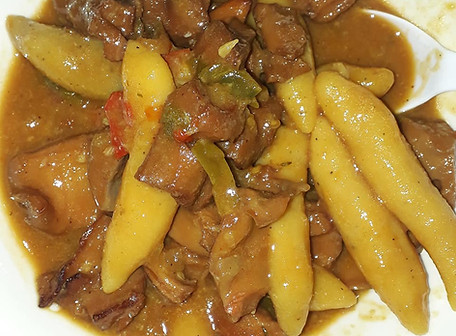
The conch is a large, protected shellfish which can be eaten steamed or preserved in vinegar. The best way to make it tender is in the pressure cooker. Dumplings are made of flour or cornmeal and boiled with the conch.

3.3.1.4 Boil(ed) Fish with Provisions
Thriving
The fish is cleaned and cut on both sides, then boiled and served with provisions (pumpkin and other root vegetables such as sweet potatoes, yams, eddos, cassava, etc.)

3.9.1.5 Fish and Fungi (Cornmeal)
Thriving
The fish is cleaned and cut on both sides, then boiled and served with provisions (pumpkin and other root vegetables such as sweet potatoes, yams, eddos, cassava, etc.)

3.10 Local Dishes
Thriving
Local dishes are usually prepared and served daily. Examples are: rice and peas, fish and dumplings or fungi, stewed goat, chicken, fish, plantain, fried rice, cassava, arrowroot, and soups. There are special occasions where specific dishes are served (i.e. ham during the Christmas season).

3.10.1 Salt Fish
Thriving
Made from salt cod, this is a savory staple dish in St. Maarten cuisine and eaten any time of the day. This is seasoned with minced vegetables and normally served with rice and peas or Johnny cakes or dumplings.

3.10.2 Saltfish & Dumplings
Thriving
Saltfish is served with dumplings, which are made of flour or cornmeal. Cattle-tongue is a special-sized dumpling shaped like a cow’s tongue.

3.10.3 Rice Dishes
Thriving
Rice dishes can be made from different types of rice, along with different types of meat, poultry or seafood, and vegetables.

3.10.3. Locri
Thriving
Made with cooked rice and broth, seasoning (spices), vegetables, and pieces of chicken; a very popular dish among the locals and also called Rice Pilaf or Cook Up.

3.10.3.2 Rice and Peas
Thriving
A rice dish with added peas (can be different types of peas) to the cooked rice and mixed with spices. The rice and peas can also be boiled together to give it a special flavor.

3.10.3.3 Stew(ed) Peas
Thriving
Soak peas overnight until soft then boil on a low temperature. Add salt or other spices.

3.11 Soups
Thriving
The soup is usually named after the meat or fish source used.

3.11.1 Peas Soup
Thriving
A rice dish with added peas (can be different types of peas) to the cooked rice and mixed with spices. The rice and peas can also be boiled together to give it a special flavor.

3.11. 2 Conch Soup
Thriving
The conch is cleaned and cooked with tomato paste, pumpkin, pimento, veggies, and peppers.

3.11.3 Oyster Soup
Thriving
The oysters are bought fresh and are cleaned and boiled with onion, garlic, and ginger. The soup is made with a creamy or watery consistency.

3.11.4 Pigtail Soup
Thriving
The pigtail is soaked overnight and boiled at least once before it is combined with peas and other vegetables and spices.

3.11.5 Bull Foot Soup
Thriving
The pigtail is soaked overnight and boiled at least once before it is combined with peas and other vegetables and spices.

3.11.6 Goat Water
Thriving
This soup is made with goat meat cut into small pieces and boiled with other ingredients and spices until tender; it is served with or without dumplings.

3.11.7 Callaloo
Thriving
A soup made with a type of locally grown wild spinach and sautéed vegetables, salt, and pepper.

3.12 Conkie
Declining
This dish combines yellow corn flour, grated sweet potatoes, pumpkin, coconuts, raisins, margarine, and sugar. Small portions of the mixture are placed in banana leaves, grape leaves, or aluminum foil and then folded, tied, and boiled in water.

3.13 Roast Corn
Surviving
Ears of fresh corn are roasted over the fire, in the coal pot, or on the barbeque grill.

3.14 Making of Local Snack
Thriving
These local snacks eaten daily and served at parties and special occasions include croquette, tuna or cheese and crackers, pig-in-a-blanket (sausages rolled in dough), patties, and deviled eggs.

3.14 Johnny (Journey) Cake
Thriving
A round bread made of flour, salt, sugar, and baking powder and fried in oil or baked. Widely prepared and eaten throughout the year and particularly during the Carnival season. Available on the menu in most local restaurants and food trucks.

3.14.3 Croquettes
Thriving
A filling is prepared from either meat, chicken, saltfish, tuna, vegetables, or cheese and placed inside dough, which is then folded and closed at the ends with fingers or fork and then fried or baked.

3.14.4 Saltfish Ball
Thriving
The saltfish is prepared by mincing it and adding spices, onions, and flour. Then it is shaped into balls, rolled in raw egg and breadcrumbs, and deep-fried.

3.14.5 Snack with Crackers (tuna, fish, cheese)
Surviving
Tuna fish is prepared with onions, mayonnaise, black pepper, and season salt and mixed together and placed on store-bought crackers. Various cheeses are diced and also placed on the crackers. These snacks are served usually at parties and other special occasions.

3.14.6 Kebabs (also called saté and made of cheese, olives, sausage, onion, chicken, meat
Thriving
Mini kebabs-The ingredients (olive, onion, sausage, and cheese) are diced and placed on toothpicks.
Kebabs-Pieces of chicken, meat or seafood are marinated and placed on wooden skewers. They can be broiled in the oven or put on the barbecue grill.

3.14.7 Deviled Eggs
Thriving
Eggs are boiled, cooled, and peeled. Then the whites are removed from the yolks and the cooked yolks are then mixed with mayonnaise, salt, and pepper to one’s taste. The yolk mixture is squeezed/spooned back unto the egg whites. This is served during special occasions.

3.14.8 Porridge/pap (cornmeal, flour, rice, arrow root, cassava, Cream of Wheat, oats)
Surviving
Water is boiled and the rice, oats, cornmeal, etc. is added to the pot and then stirred until cooked. During the cooking process, other ingredients such as milk and spices are added

3.15 Local Candies and Sweets
Thriving
Local sweets are usually prepared at home and sold by vendors in small stores or on the roadside.

3.15.1 Tarts (coconut, guava, prune, guavaberry, pineapple, stewed tomatoes)
Thriving
Tarts are prepared with filling of locally picked or canned fruits. The delicacies can be ordered from the bakers or bought at stores, in the market, or during festivals.
3.15.2 Sugar Cakes
Thriving
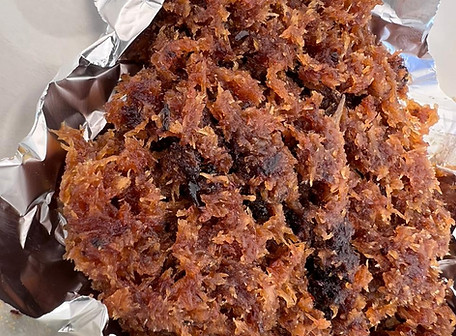
Grated coconut is mixed with brown sugar, water, milk, flavor, and coloring. Then it is boiled until syrupy, cooled, and cut in pieces or rolled in balls and sold along the road or at special occasions.

3.15.3 Pudding (potatoes, sweet potatoes, bread)
Thriving
Potatoes/sweet potatoes are grated and mixed with sugar, margarine and grated pumpkin. For the bread pudding, raisins, cinnamon, nutmeg, prunes and rum are usually added.

3.15.4 Cakes (black, fruit, carrot)
Thriving
These are made by using a plain cake recipe with butter, flour, eggs, milk/water, and salt. Fruits of your choice are added and mixed in and the cake is baked in the oven. Fruit and black cakes are mostly prepared during the Holiday season and for weddings.

3.15.5 Tamon or Tamarind Balls
Thriving
Tamarind paste (with or without hot sauce), salt, and sugar are shaped into bite-size balls and dusted with sugar.

3.15.6 Jams (cashew, gooseberry, guava, stewed tomatoes
Thriving
These are made by fruits being cleaned and stewed in water. Sugar is added until it is thickened. The jams are used on bread, cookies, and/or in tarts.

3.15.7 Guava Cheese
Declining
The same procedure as used with the jam used here, but the guava becomes thicker in substance, sometimes by using gelatin. After cooling, it is cut into pieces and sold or presented in that way.

3.16 Drink Preparation (Local Alcoholic and non-alcoholic Drinks)
Thriving
Making of juices and/or fermented beverages from fruits, parts of fruits, or bark grown locally. The preparation and consumption of locally made beverages are an integral part of St. Maarten’s history, culture, and identity.

3.16.1 Fruit Juices
Thriving
Whenever a certain fruit is in season, it is picked, cleaned, and prepared for boiling or brewing. Water and sugar, and sometimes other flavors, are added to make it into refreshing delicious drinks.

3.16.1.1 Sorrel Juice
Thriving
This is made from a flowering red plant and brewed to produce a rich liquid. Sugar is added and the juice is served cold. It is mostly consumed during the Christmas holiday season.

3.16.1.2 Tamarind or “Tamon” Juice
Thriving
Made from the fleshy pods of the tamarind tree. It is boiled, sweetened, and served cold.

3.16.1.3 Lime Juice
Thriving
Made by squeezing limes and adding water and sugar to the juice. It is served cold.

3.16.1.4 Soursop Juice
Thriving
Made by peeling the soursop, adding milk, and letting it steep. The seeds are removed, spices are added if desired, and it is served cold. Instead of milk, water can be used.

3.16.1.5 Passion Fruit
Thriving
Made by taking the pulp out of the passion fruit and adding water and sweetener. The seeds are sifted out and it is served cold.

3.16.2 Ginger Beer
Thriving
The ginger root is grated, boiling water is added, and it is rested for hours or days depending on the desired strength. It can be drunk as is or rum can be added.

3.16.3 Rum
Surviving
Rum making is done by crushing the sugar cane stalks, extracting the juice, and distilling the liquid produced from fermented sugar cane juice. It is often used in our local beverages.

3.16.3.1 Guavaberry
Thriving
Made by extracting small guava berries, adding spices such as cinnamon, nutmeg, sugar, and other ingredients and put in a bottle to ferment for several weeks; served during the Christmas season.

3.16.3.2 Mauby
Thriving
Made by extracting small guava berries, adding spices such as cinnamon, nutmeg, sugar, and other ingredients, and put in a bottle to ferment for several weeks; served during the Christmas season.

3.16.4 Punches from fruits (lime punch/Ti punch, pomserrette, guavaberry )
Thriving
Rum and brown sugar are added to the fruit, soaked for a few weeks, and served in small glasses. The longer the fruits are steeped in the rum, the stronger the drink becomes. The punches are popular during special occasions.

3.16.5 Bush Teas
Thriving
Herbs such as lemongrass, basil, mint, etc. are selected, washed, and then placed in a pot or cup, and boiling water is poured over it. It is steeped before drinking. Some bush teas are made by boiling the herbs in the water for a while before cooling and drinking.